Potty training without the power struggle: a calm plan for UK parents
Ditching nappies, the calm way. A 3-day start, a 14-day plan to make it stick, scripts and fixes for 14 common problems. Built on NHS and AAP guidance.
Get the plan · $27 Is my child ready?
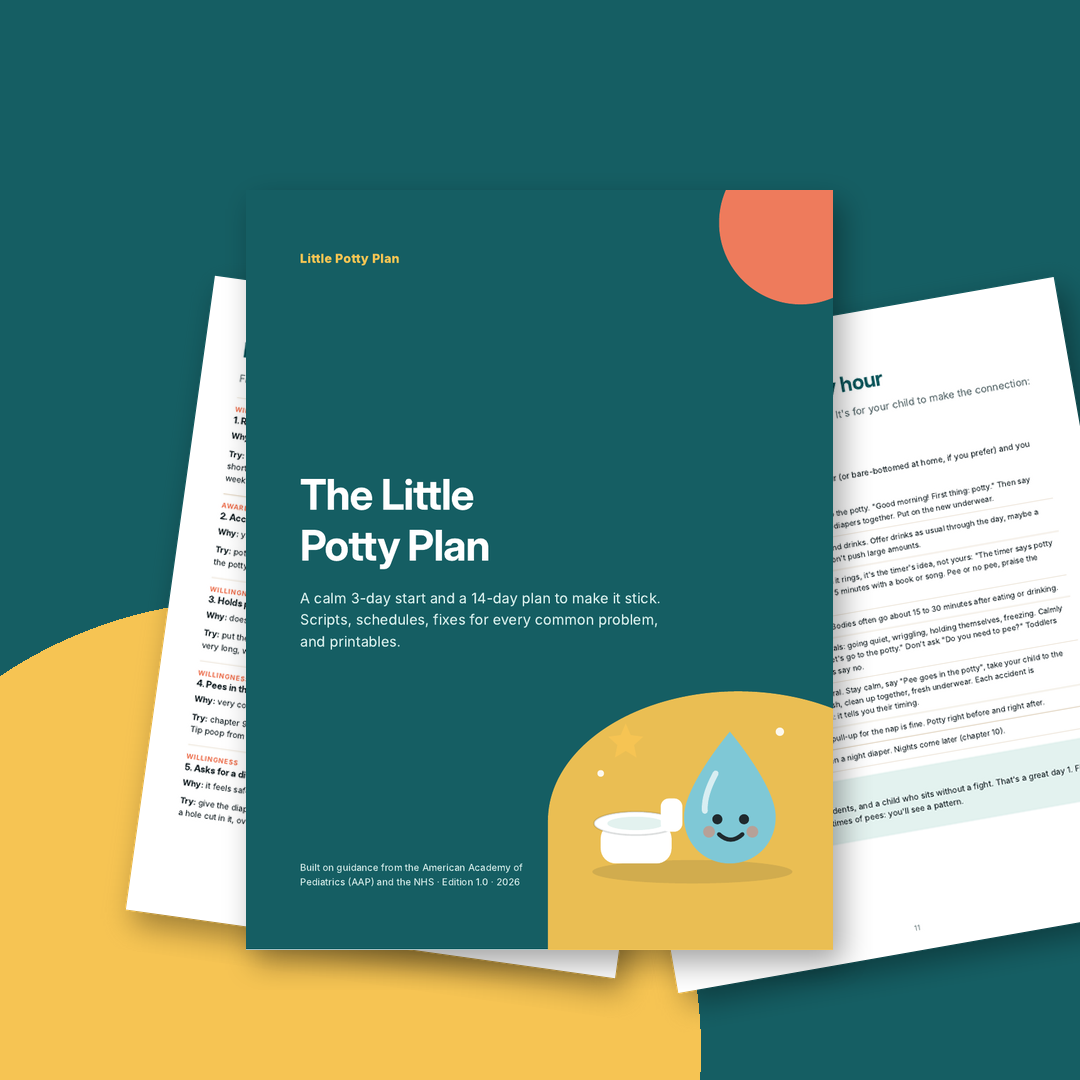
- 35-page PDF + 10 printables
- Instant download
- 30-day money-back guarantee
This plan follows the NHS five-step approach (tell your child, stop daytime nappies, build routines, praise effort, build independence) and adds an hour-by-hour plan, scripts and troubleshooting. It is written in US spelling (diapers rather than nappies), but the method is the same. Talk to your health visitor if you have concerns: the NHS suggests asking about potty training at the 2 to 2.5 year review.
You've read twenty articles and you still don't know what to do on Monday morning.
One says wait for readiness signs, the next says don't wait. One promises a dry child in three days, the next says that's a myth. Meanwhile your toddler hides behind the couch to poop, daycare asks when you're starting, and you're wondering if you're already late.
You're not late. According to the AAP, most U.S. children start potty training between 2 and 3 and are trained by age 4. What you're missing isn't information. It's a plan: what to do, in what order, and what to say when it goes sideways.
Sources: AAP, The Right Age to Potty Train.
Three phases. One calm plan.
1. Prep week
Seven small steps, ten minutes a day: the potty in sight, the right words, practice moves, choosing underwear. Your child knows what's coming.
2. The 3-day start
Three focused days at home with an hour-by-hour plan. The goal isn't perfection. It's the click: "I feel something, I go to the potty."
3. Days 4 to 14
From timer to routine, first outings, daycare and grandparents, so the first successes turn into a habit that lasts.
Everything you need, nothing you don't.
- 1. What the experts actually say
Ages, readiness and the methods, from the AAP and NHS, in plain English. - 2. The 2-minute readiness check
Know whether to start now, prepare first, or wait a month. - 3. The prep week
Seven 10-minute steps that make the three days much easier. - 4. Choosing your three days
Shopping list, the parent agreement, and what to plan around. - 5. The 3-day start, hour by hour
Exactly what to do on day 1, 2 and 3, and where you should be after. - 6. What to say
Word-for-word scripts for prompts, praise, accidents and "No!". - 7. Days 4 to 14
From timer to routine, outings, stickers and the first public toilet. - 8. 14 problems and fixes
Refusing, holding, poop accidents, daycare, regression, a new baby, and more. - 9. Poop
Why it's harder, the poop routine, and how to spot constipation. - 10. Naps and nights
When to try, how to try, and why bedwetting is so common. - 11. Daycare and grandparents
How to get everyone doing the same thing. - 12. When to call the doctor
The red flags, based on the AAP list.
Plus 10 printables
- Readiness checklist
- Potty chart (35 spaces)
- 3-day log
- Potty steps routine cards
- Parent agreement
- Sticker sheet
- Dry night chart
- "I did it!" certificate
- Caregiver sheet for daycare
- Going-out checklist
Built on what pediatricians actually recommend
There's no secret method. There's good guidance, scattered across dozens of pages. We put it in order and turned it into a plan you can follow.
"No method is perfect for every child"
That's the AAP's view. The plan combines a short focused start with a gentler routine, and adapts to your child's style.
Praise beats punishment
The AAP says children learn best when praised for progress rather than punished for mistakes. Every script in the plan follows that.
Check for constipation first
The NHS advises checking this before you stop diapers. It's the most common reason training stalls, and chapter 9 covers it.
Sources: AAP, Which Method is Best?; AAP, Create a Potty Training Plan; NHS, Potty training your child.
The 1-minute readiness check
Tick what you've seen in the past two weeks.
Your score: 0 of 10
Looks like a great time to start. Pick three calm days at home in the next couple of weeks and do a short prep week first. The plan walks you through it hour by hour.
Nearly there. Most children add two or three signs within a week or two of preparation: a potty in the bathroom, books, naming pee and poop as it happens. The NHS says you don't have to wait for every sign.
Read the readiness guide or get the full plan, which includes a 7-day prep plan.
Start with preparation, no pressure. Put a potty out, read potty books, change diapers in the bathroom. Check again in a month. If your child is over 3 with few signs, mention it at your next checkup.
Get the free chart to start practicing sitting.
The numbers every worried parent should know
| Fact | Source |
|---|---|
| Most U.S. children are trained for pee and poop by age 4. | AAP |
| About 15% of 5-year-olds still wet the bed. It's not your child's fault. | AAP |
| Regression usually lasts a few days or weeks. | AAP |
| Accidents are normal and happen to most children. | NHS |
Sources: AAP, The Right Age; AAP, Bedwetting; AAP, Regression; NHS.
Why a plan beats another blog post
| Free articles | The Little Potty Plan | |
|---|---|---|
| Hour-by-hour plan for the first 3 days | Rarely | Yes |
| What to do on days 4 to 14 | Usually missing | Day-by-day |
| Fixes for refusal, poop, daycare, regression | Scattered over many sites | 14 problems in one chapter |
| Word-for-word scripts | Sometimes | For every common moment |
| Printables | One chart, if you're lucky | 10, ready to print |
| Sources you can check | Often none | AAP and NHS, per chapter |
$27$37
One-time payment · instant PDF download · no subscription
- 35-page plan: prep week, 3-day start, days 4 to 14
- Scripts for prompts, praise, accidents and "No!"
- 14 common problems with causes and fixes
- Poop, naps and nights, daycare chapters
- 10 printables, including chart and stickers
- Sources from the AAP and NHS in every chapter
Secure checkout via Payhip. Pay by card or PayPal.
A plan written the way you'd want a friend to explain it
Little Potty Plan is a small independent project from the Netherlands. I'm Michiel, and I've spent 25 years turning complicated information into clear, practical writing. When it was time to make a potty training plan, I found plenty of opinions and very little structure. So I went to the sources pediatricians use, the AAP and the NHS, and built the plan I'd want to follow myself.
I'm not a doctor, and this plan doesn't pretend otherwise. What it does is put the official guidance in order, translate it into steps and scripts, and tell you clearly when to call your doctor. More about this project.
Frequently asked questions
Will my child be potty trained in 3 days?
Some children are. Many make huge progress in three days and need a couple of weeks to make it reliable, which is why the plan includes days 4 to 14. Every child is different, and the plan is built for that.
What age is this plan for?
For children who are roughly 18 months to 3.5 years old. The AAP says children generally show bladder and bowel control between 18 and 24 months and most U.S. children start training between 2 and 3. The NHS says almost all children can be trained between 18 months and 2.5 years. The plan also works for children over 3.
Who wrote it? Is it medical advice?
It's written by Little Potty Plan, a small independent publisher. It isn't medical advice and we're not doctors. Every age, sign and warning in the plan comes from the American Academy of Pediatrics (AAP) and the NHS, with sources listed. Chapter 12 tells you exactly when to call your doctor.
Is it a physical book?
No, it's a 35-page PDF you can read on your phone and print at home. The 10 printables (chart, stickers, routine cards, logs, certificate, caregiver sheet) are designed for regular paper.
Does it work for boys and girls?
Yes. There are specific sections on boys (sitting first, aiming later) and girls (wiping front to back), plus everything that's the same for both.
What if my child refuses or we have to stop?
Chapter 8 covers refusal, holding pee, poop accidents, fear of the toilet, regression and more. It also tells you honestly when pausing for a few weeks is the better choice, and how to restart.
What does the money-back guarantee cover?
If the plan isn't useful to you, email us within 30 days of purchase and you'll get a full refund. No forms, no questions about how hard you tried.
Ready for a calmer start?
Get the plan today, print the chart tonight, and pick your three days this week.
Get the plan · $27Not ready to buy? Start with the free potty chart.